Archives - Page 2
-
Anuario de Espacios Urbanos, Historia, Cultura y Diseño
No. 10 (2003)The Anuario de Espacios Urbanos, Historia, Cultura, Diseño celebrates a decade. The reader has in his hands issue number ten of a publication that has been, from the beginning, a committed academic and intellectual in exploring themes and methods for the study of the city and the urban. It is good to know that the Anuario was conceived by a group of researchers attached to a university design school, that is, to the Division of Sciences and Arts for Design of the Universidad Autónoma Metropolitana (Azcapotzalco). This news may be interesting. On the one hand, not all the founders of the Anuario have been architects or designers, but rather several of them come from the social sciences and humanities (sociologists, anthropologists, historians). Otherwise, however, architects and urban planners have permanently raised challenges in terms of the pertinent perspectives and the necessary methodologies in this academic practice, in such a way that the horizons of the publication have widened seen widened and questioned. There is not in sight a synthesis or a conclusion of what the Anuario has thrown into the intellectual life of the Universidad Autónoma Metropolitana and that of its own readers. In any case, a tangible result is the very possibility of maintaining for ten years a minimum intellectual (and university) consensus on the need for a publication organized around problems and research themes, and not around disciplines enunciated from the cold taxonomy of a manual of the International Labor Organization. For the rest, the Anuario was not conceived as a mode of expression only or mainly by the professors who founded it. On the contrary, the founders thought from the beginning that the Anuario was a publication offered to the academic community inside and outside the University. We made an offer, we created a space that was available to others. We only demand the minimum of quality and relevance, dictated by our experience and our knowledge.It is still a paradox that with all the budgetary and political disadvantages that the public university has today compared to private education, one of its bulwarks continues to be risk. As we all should know, research basic education, applied research, reflection and social criticism, and teaching that seeks to innovate by using the results of scientific and humanistic research are, all together and each one at the same time, risky companies. Beyond the planning exercises, and the order and concert to which we are all obliged in the management of public money, the tangible and measurable results of all these activities are not always predictable. The moment in which they will affect for the better the society and the culture from which they arise and to which they are due, is rather alien to the prophecies of planning, even though in the medium and long times their impacts will be visible to all. The Anuario has been a risk assumed for ten years by the Universidad Autónoma Metropolitana, with full awareness. Ideally, reading should also be a risk. Perhaps this is impossible in each issue and in each article, but we like to think that this should be the dominant trend in the relationship between the text and the reader. Reading as risk, the risk of reading. In the eight articles that make up this installment, the reader will know if it was worth it. Ariel Rodríguez KuriNovember 2003 -
Anuario de Espacios Urbanos, Historia, Cultura y Diseño
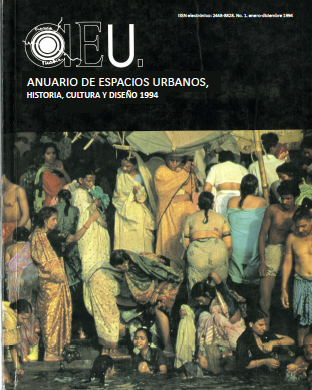
No. 01 (1994)If we could express the greatest concern of the authors of the Yearbook. We would say with Gide: "Everything has been said, but since no one pays attention, we always have to start again." This publication on the urban is the result of the intentionality of different researchers who make up the Urban Planning area of the Department of Design Evaluation over Time. Different perspectives such as the historical, the planning, the economic, the anthropological, the sociological and the architectural itself that respond to the fact that the city becomes an entity that cannot be exhausted with a single reading, since it will always exist, a enormous disproportion between a finite space and the infinite imagination of the researcher that allows him to interpret it from very many angles. Those of us who designed the Yearbook conceive the city as a complex entity that can hardly be covered by a single discipline. Baste mentions that the Enacarta 94 Encyclopedia has 605 references to the concept of urbanism: from municipal government, education and urban planning, to industry, social movements, police and commerce, history, music, pollution, public transportation and agriculture. The study of urban areas requires the collaboration and participation of several specialists who, at different levels and levels, can shed light on the economic, political and social aspects conceived as a city. We could say that the spirit that animates the Yearbook is like that of the Dada movement, which was born at the beginning of the century to exalt, almost recalcitrantly, individualism, the petit-bourgeois protest against facism, synonymous with intolerance and outdated morality. We feel, then, committed to the principles of tolerance for free acts and the acceptance of personal expressivity, rebellion in behavior and, why not?, the subversive bias of Dadaism. The design of the Yearbook comes from Francis Picabia's 1919 Dada drawing entitled The World. The logo was selected, adapted and redesigned by Stella Fabbri, who from our first indecisions knew very well what we wanted.